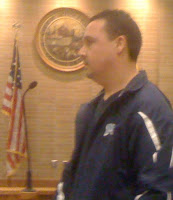
An application for a special exception revealed a sad split in the Armetta family, between the father, Phil, and his 5 children. A dispute over land and the Dainty Rubbish company complicates the children's application to consolidate all of Dainty's operations on a 2.5 acre parcel owned by the children. In addition to the Armetta family, the dispute drew in Bill Corvo, a partner with Phil Armetta in the Kleen Energy power plant.
Phil Armetta was the owner and operator of Dainty Rubbish, he also owned the two lots on which Dainty Rubbish operated, 80 and 90 Industrial Park Road in Westfield. Shortly before being sentenced to jail for concealing knowledge of a felony, Armetta turned ownership of Dainty Rubbish to his children. The children also were given the front of the two lots on which Dainty Rubbish operates (80 Industrial Park). Phil Armetta retained ownership of the rear lot (90 Industrial Park).
Since the ownership change, the Dainty Rubbish Company has been leasing land from the two property owners to continue its operation. The application before Planning and Zoning was for a special exception that would allow Dainty Rubbish to conduct all operations solely on the front lot (owned by the children). The company would move the truck scale to the front lot and build a scale house and a maintenance garage.
Showing posts with label phil armetta. Show all posts
Thursday, December 13, 2012
Thursday, August 5, 2010
Inland Wetlands Denies Cost-Cutting Plan for Wetlands Mitigation
Businessman Phil Armetta's request to alter the conditions of his permit for wetlands destruction on Newfield Street was unanimously denied by the Inland Wetlands Agency last night. Commissioners all agreed that they could not alter the plan devised by wetlands expert Richard Snarski without any expert testimony that the substitution of a low-cost seed mixture would be just as good at wetlands creation as the original plan, which called for planting already growing plants.
"We're 95% Complete"
Seth Sevimli, owner of the Auto Store II used car dealership, opened the discussion with an explanation of what they had done on Newfield Street since their excavation and placement of a stone surface on the former wetlands. The retroactive permit for this work was based on a plan which mandated an earthen berm, 1.5 to 2.0' high between the lot and the Newfield Street, seeded and mulched. It further mandated that topsoil be used to restore the natural grade of the wetland, and then seeded with a wetlands mix. Finally, the plan called for paving of the parking area and the construction of a curb and leak-off to protect the remaining wetlands from parking lot run-off (full plan here).
Sevimli said this work was nearly complete. He said that Matt Dodge, environmental specialist in the Planning Department, had inspected it and asked only that more topsoil be added to restore the elevation of the wetlands. He said that this would be done shortly and then the wetlands
seed mix would be planted.
"We don't have anything from Mr. Snarski."
Sevimli then turned to his request to change the conditions of the permit for the paving work. He asked the Agency for permission to alter what was to be planted at the wetlands mitigation site near the Mattabessett River. Citing the high cost of the originally planned plantings, and the approval of the much cheaper seed mixture around the parking lot, he asked why it wouldn't be possible to use the same seed mixture in the back property, near the River.
Joe Carta, Chair of Inland Wetlands, asked whether there was a letter or any other evidence that the seed mixture would be just as good at wetlands creation. Sevimli readily admitted that he had no letter from Snarski or any other expert in soils or wetlands vegetation. He pointed to the similarity in the list of species in the seed mixture to those in the wetlands mitigation plan approved by Inland Wetlands, "I didn't think I needed a scientist."
Sevimli told the commissioners that he had not contacted Snarski because of the high fees he was being charged. He said he had paid $3500 to Snarski for the initial report which allowed him to get the parking lot permit, and that further consultation with Snarski would lead to costs he was unwilling to bear.
"I've done a lot for this city."
Carta's continued skepticism over the justification for changing the plan brought a very agitated Phil Armetta to the podium. Armetta owns both the car dealer lot and the lot where the wetlands mitigation is planned. He reiterated Sevimli's argument that if the seed mixture was good enough for the front, around the parking lot, it ought to be good enough for the back, "They want to smell the flowers, we'll put a rose plant in the front, they can smell the flowers there. ... Who goes back there to look at it anyway?"
Armetta blasted the Agency for not understanding or supporting businesses, "This is why Connecticut is last in job creation--this kind of stuff."
A Soil Scientist Speaks
James Sipperly, Environmental Resource Specialist for the City, and a registered soil scientist who works in the City Water and Sewer Department was at the meeting for another matter. The commissioners asked Sipperly to speculate on the reasons why the plantings used adjacent to the parking lot on Newfield Street might be different from the plantings used adjacent to the tidal wetlands of the Mattabesset. He suggested that the quality of the wetlands functioning might be different, that there was more emphasis on biodiversity near the river, and that putting in already growing plants could help compete out the invasive plant species more effectively than planting seeds would do.
The Plan Remains the Same
Extensive further discussion between the commissioners and Armetta largely consisted of each charging the other with a lack of understanding of what was important. In the end, the commissioners voted unanimously to deny the request to change the mitigation part of the wetlands permit given to Armetta for the parking lot expansion and destruction of wetlands.
Wednesday, August 4, 2010
Wetlands Agency to Consider Amendment to Mitigation Plan on Newfield Street
Background
Details of the Mitigation Plan
The plan also called for the installation of nearly 1000 herbaceous wetland plants, listing 10 different species including Monkey Flower, Blue Flag Iris, Soft Rush, and Sweet Flag. The 1000 herbaceous plants will cost nearly $1000 at the primary source for wetlands plants in New England.
Seth Sevimli, owner of the Auto Store II, told me that since the parking lot expansion was for his business, he is taking responsibility for the wetlands mitigation. He was proud of the work done so far on the future wetlands and invited me to go out to the site, which I did. As stated in the mitigation plan, large wooden timbers have been removed, and a bulldozer has excavated about a foot of clay-like soil. The mitigation site is at the edge of about 25 acres which form a peninsula into the Cromwell Meadows, bounded on the west by railroad tracks, and on all other sides by the Mattabessett tidal wetlands.

Delays and Extensions
I asked Joe Carta, Chair of the Inland Wetlands Agency, about the delay in the project from the date specified in the application (April, 2010). He said that he had heard nothing about any delays in the project, but that he did not expect to. He said that usually the applicant phones up the Planning Office, tells them the work is done and then Driska goes out to inspect the work. Driska confirmed this, saying that most developers are eager to get approval for work relating to wetlands, so that they can move forward with their development.
Carta said that once an application goes through the Wetlands Agency and is approved, they rely on city staff to monitor it. I asked him what would happen if a developer never notified the city that they had completed an agency-required mitigation. He said, “Probably what happens is it [the project approval] gets lost.”
Sevimli said that the delay in his project was because the spring was so wet that heavy equipment could not do the excavation, and then a death in the Schools family caused a second delay. Matt Dodge, Environmental Specialist in the Planning Office, confirmed that Sevimli had been in contact with both him and Driska about the delay, and they had given verbal extensions to the mitigation project.

In August of last year, about 1000 square feet of wetlands were bulldozed and filled with large stones (riprap). Zoning and Wetland Enforcement Officer Bruce Driska brought this to the attention of the Wetlands Agency, who first heard from Armetta at their September meeting.
Armetta told the Wetlands Commissioners, “We wanted ... to get a little more exposure of the dealership to cars.” A soil scientist hired by the city reported in October that “wetland has been totally impacted by the removal of 1-2 feet of the former wetland surface layers and the placement of a stone surface layer.”
The Agency asked Armetta to submit a retroactive application for the impact on wetlands. Armetta’s application for a wetlands permit to do the parking lot expansion was considered at the March meeting, and unanimously approved. The application included a detailed plan not only for the parking lot area, but also for the enhancement of 3000 square feet of existing wetlands and the creation of 1500 square feet of new wetlands. These were both designed by Richard Snarski, a Registered Soil Scientist. The enhancement and creation of wetlands would take place on a separate parcel, adjacent to the Cromwell Meadows which line the Mattabessett.
Details of the Mitigation Plan

The Wetland Creation and Enhancement plan approved by the agency is quite detailed (the full plan is available HERE). These details included the time of construction (April, 2010), the depth of excavation (6-12 inches), the material placed in the created wetlands (topsoil or leaf compost), removal of invasive plants (for three years with either a hand shovel or an herbicide), and the monitoring (a report on the wetlands to be sent every year for three years).
The plan also called for the installation of nearly 1000 herbaceous wetland plants, listing 10 different species including Monkey Flower, Blue Flag Iris, Soft Rush, and Sweet Flag. The 1000 herbaceous plants will cost nearly $1000 at the primary source for wetlands plants in New England.
Seth Sevimli, owner of the Auto Store II, told me that since the parking lot expansion was for his business, he is taking responsibility for the wetlands mitigation. He was proud of the work done so far on the future wetlands and invited me to go out to the site, which I did. As stated in the mitigation plan, large wooden timbers have been removed, and a bulldozer has excavated about a foot of clay-like soil. The mitigation site is at the edge of about 25 acres which form a peninsula into the Cromwell Meadows, bounded on the west by railroad tracks, and on all other sides by the Mattabessett tidal wetlands.
The land is currently being used for dumpster storage and an asphalt recycling business operated by LeeBoy Paving, but in past years it housed clay pits, was used to stage construction equipment, and likely also had other light industrial uses.
Changes to the Mitigation Plan?
The amendment being considered tonight would radically alter the type of plantings in the wetlands being created as mitigation.
Sevimli said he would prefer to use a wetlands seed mix on the created wetlands, the same mix that the agency said was appropriate for the small area of wetlands that remains around the parking lot. He wondered why the more expensive mixed herbaceous wetlands plants would be used far away from where people would see it, “Who needs flowers out in the middle of the woods?” The wetland seed mix costs $125 per pound, 2 pounds is said to cover 5,000 square feet.
Sevimli said that they would abide by whatever the Agency ruled, “... if that’s what they want that’s what we’ll do.”
He said that Armetta was paying close attention to the work, “He’s here twice a week making sure we’re doing what we’re supposed to do.” He said that Armetta’s company did some of the work in the plan, but the earth moving in preparation for planting the wetlands plants had been done by Bob Schools, who has built other wetlands in the area.
Sevimli said that they would abide by whatever the Agency ruled, “... if that’s what they want that’s what we’ll do.”
He said that Armetta was paying close attention to the work, “He’s here twice a week making sure we’re doing what we’re supposed to do.” He said that Armetta’s company did some of the work in the plan, but the earth moving in preparation for planting the wetlands plants had been done by Bob Schools, who has built other wetlands in the area.
Delays and Extensions
I asked Joe Carta, Chair of the Inland Wetlands Agency, about the delay in the project from the date specified in the application (April, 2010). He said that he had heard nothing about any delays in the project, but that he did not expect to. He said that usually the applicant phones up the Planning Office, tells them the work is done and then Driska goes out to inspect the work. Driska confirmed this, saying that most developers are eager to get approval for work relating to wetlands, so that they can move forward with their development.
Carta said that once an application goes through the Wetlands Agency and is approved, they rely on city staff to monitor it. I asked him what would happen if a developer never notified the city that they had completed an agency-required mitigation. He said, “Probably what happens is it [the project approval] gets lost.”
Sevimli said that the delay in his project was because the spring was so wet that heavy equipment could not do the excavation, and then a death in the Schools family caused a second delay. Matt Dodge, Environmental Specialist in the Planning Office, confirmed that Sevimli had been in contact with both him and Driska about the delay, and they had given verbal extensions to the mitigation project.
Richard Snarski said he was not doing the actual earthmoving or planting to create the wetlands, his only role was to design it and supervise the construction, "I don't have a contract." He said he was waiting for the excavation work to be done and had heard nothing about the project, "I guess things got delayed."
The parking lot on Newfield Street, the original trigger which led to the mitigation plan, was paved in the first week in July. It is in active use, although the wetlands seed mix is yet to be planted at its edge.
Other Items on the Agenda
The Wetlands Agency will also consider the "General Permit" for the City of Middletown Water/Sewer Department, which covers activities needed for servicing the existing water and sewer systems. They will review the situation at Charton Apartments with respect to the landslide which clogged the Cogingchaug. Finally, there will be a public hearing over the proposed installation of city water on Country Club Road from Middle Street to Higby Road.
Sunday, July 18, 2010
From 1980: Trash Hauler Files Appeal Over Dumping Ordinance
The following article was published exactly 30 years ago today, appearing in the Hartford Courant of July 18th, 1980.
-------------------------
A garbage hauler, whose license to dump refuse at the city landfill was ordered suspended for 10 days after he was accused of dumping refuse from another town, filed a court appeal Thursday, challenging the city ordinance that prohibits dumping refuse from most other towns.
In a ruling announced last week, acting Public Works Director Nicholas Misenti imposed the suspension on Dainty Rubbish Service Inc. In a hearing June 24, a Middletown policeman testified that he had seen a truck from the company pick up garbage in Rocky Hill and drop it at the Middletown dump -- violating the recently enacted city ordinance.
Superior Court Judge James Higgins has ordered a hearing for Monday at 2 p.m. on Dainty’s request for an injunction halting the suspension, which was ordered to begin today.
Phillip Armetta, the president of Dainty, said at the hearing that he didn’t order the driver to truck Rocky Hill garbage to the Middletown dump, and that he had fired the driver who is accused of trucking the garbage. He later described the penalty as excessively harsh, particularly because he recently donated part of the land now used for the landfill.
Misenti said the 10-day suspension was the lightest penalty that could be imposed under the ordinance, which has no provision for firms whose licenses are suspended to appeal.
The seven-page complaint filed in Middlesex County Superior Court contends that the ordinance, which regulates only garbage dumping at the city dump on Johnson Avenue, limiting it to waste from Middletown and Cromwell, was not approved by proper state authorities and not included in the city’s solid waste management plan filed with the state in July 1979.
Dainty claims the ordinance is unconstitutional, not approved by proper state authorities, and in conflict with state laws.
-------------------------
A garbage hauler, whose license to dump refuse at the city landfill was ordered suspended for 10 days after he was accused of dumping refuse from another town, filed a court appeal Thursday, challenging the city ordinance that prohibits dumping refuse from most other towns.
In a ruling announced last week, acting Public Works Director Nicholas Misenti imposed the suspension on Dainty Rubbish Service Inc. In a hearing June 24, a Middletown policeman testified that he had seen a truck from the company pick up garbage in Rocky Hill and drop it at the Middletown dump -- violating the recently enacted city ordinance.
Superior Court Judge James Higgins has ordered a hearing for Monday at 2 p.m. on Dainty’s request for an injunction halting the suspension, which was ordered to begin today.
Phillip Armetta, the president of Dainty, said at the hearing that he didn’t order the driver to truck Rocky Hill garbage to the Middletown dump, and that he had fired the driver who is accused of trucking the garbage. He later described the penalty as excessively harsh, particularly because he recently donated part of the land now used for the landfill.
Misenti said the 10-day suspension was the lightest penalty that could be imposed under the ordinance, which has no provision for firms whose licenses are suspended to appeal.
The seven-page complaint filed in Middlesex County Superior Court contends that the ordinance, which regulates only garbage dumping at the city dump on Johnson Avenue, limiting it to waste from Middletown and Cromwell, was not approved by proper state authorities and not included in the city’s solid waste management plan filed with the state in July 1979.
Dainty claims the ordinance is unconstitutional, not approved by proper state authorities, and in conflict with state laws.
Thursday, March 4, 2010
A Boy Scout at Inland Wetlands
Retroactive permit granted.
The Agency approved the application by Phil Armetta for a permit to damage about 1000 square feet of wetlands on Newfield Street. As part of the application, Armetta proposed to enhance a 3000 square feet, man-made wetlands, and to create a new 1500 square feet wetlands, both on a nearby property very close to the Mattabesset River. The property is on the other side of the railroad tracks between Newfield Street and the Mattabesset (see picture below), at the edge of the "Floating Meadows" which line the Mattabesset near its confluence with the Connecticut.
The wetlands creation and enhancement plan was put together by Richard Snarski, a Registered Soil Scientist, Professional Wetlands Scientist, and Certified Sediment & Erosion Control Specialist. Snarski indicated that the existing man-made wetlands has no topsoil. The proposal calls for excavation of 6-12 inches, followed by filling with either topsoil or leaf compost, and the placement of wood debris to provide structure for wildlife. The area will be seeded with appropriate grasses, and nearly a thousand herbaceous wetland plants, including sedges, iris, monkey flower, and Canada rush.
Exotic, invasive plants and cattails will be removed for three years after construction, eradicated either by digging with a hand shovel, or spraying with herbicide "Rodeo". The wetland will be monitored for three years, with annual monitoring reports sent to the Inland Wetlands Agency.
The original parking lot expansion on Newfield Street, which destroyed wetlands, will not only remain, but it will become paved. Zoning Enforcement Officer Bruce Driska told me after the meeting that the slope of the lot after paving will improve the current situation, as it will cause some of the water run-off to move away from wetlands on the neighboring property (the
The wetlands creation and enhancement plan was put together by Richard Snarski, a Registered Soil Scientist, Professional Wetlands Scientist, and Certified Sediment & Erosion Control Specialist. Snarski indicated that the existing man-made wetlands has no topsoil. The proposal calls for excavation of 6-12 inches, followed by filling with either topsoil or leaf compost, and the placement of wood debris to provide structure for wildlife. The area will be seeded with appropriate grasses, and nearly a thousand herbaceous wetland plants, including sedges, iris, monkey flower, and Canada rush.
Exotic, invasive plants and cattails will be removed for three years after construction, eradicated either by digging with a hand shovel, or spraying with herbicide "Rodeo". The wetland will be monitored for three years, with annual monitoring reports sent to the Inland Wetlands Agency.
Toyota dealership).
Commissioner Hector Bartoli asked Snarski if hydrocarbons from oil and gasoline could travel from the parking lot into the wetlands. Snarski acknowledged they would, and agreed to shorten the parking lot and to plant a strip of grass which would filter the water before it went into the wetlands.
Commentary.
More generally, and in my opinion, unfortunately, this is not the only retroactive application which has recently been approved in City Hall. Within the past month, citizens elected or appointed to the Inland Wetlands Agency and the Planning and Zoning Commission, have given unanimous permission for actions which violated regulations but were already done. Although each of these decisions was a reasonable one, they are part of a pernicious pattern which I have heard many in City Hall characterize as, "It is easier to ask for forgiveness than to ask for permission."
This approach to land use decisions is unfair to the responsible residents of the city, who may suffer delay, frustration, and extra costs for being aware of and following the regulations. For someone who follows the rules, it must be galling to see a car dealership benefit for six months from an extra parking lot created without any consideration of the required wetlands destruction permit.
The "forgiveness" approach also jeopardizes the land, by reducing or eliminating any penalties for ignoring the regulations of the city and the state. In this particular case, the wetlands destroyed was not a significant loss to the environment or flood control. However, one does not have to look far to find highly significant wetlands which are bordered by land coveted for other uses. In fact, the wetlands which will be created by tonight's application are between the Cromwell Meadows and land which Armetta wishes to develop for future uses, according to Snarski.

Commissioner Hector Bartoli asked Snarski if hydrocarbons from oil and gasoline could travel from the parking lot into the wetlands. Snarski acknowledged they would, and agreed to shorten the parking lot and to plant a strip of grass which would filter the water before it went into the wetlands.
Commentary.
The kerfuffle which began with the unauthorized destruction of wetlands by Phil Armetta 6 months ago has ended with an agreement with the potential to increase the quality and
quantity of wetlands in the Mattabesset River floodplain. The application put together by Snarski is specific enough that it will be straightforward for the Zoning Enforcement Officer of the Planning Department to verify compliance with its proposals.
The ZEO should verify that the use of "topsoil or leaf compost" and "wood debris" is responsible and appropriate for wetlands and wildlife habitat. Most importantly, the ZEO should verify that the annual "monitoring reports" accurately reflect what the application promises, in terms of plantings and removal of exotic invasive species.
More generally, and in my opinion, unfortunately, this is not the only retroactive application which has recently been approved in City Hall. Within the past month, citizens elected or appointed to the Inland Wetlands Agency and the Planning and Zoning Commission, have given unanimous permission for actions which violated regulations but were already done. Although each of these decisions was a reasonable one, they are part of a pernicious pattern which I have heard many in City Hall characterize as, "It is easier to ask for forgiveness than to ask for permission."
This approach to land use decisions is unfair to the responsible residents of the city, who may suffer delay, frustration, and extra costs for being aware of and following the regulations. For someone who follows the rules, it must be galling to see a car dealership benefit for six months from an extra parking lot created without any consideration of the required wetlands destruction permit.
The "forgiveness" approach also jeopardizes the land, by reducing or eliminating any penalties for ignoring the regulations of the city and the state. In this particular case, the wetlands destroyed was not a significant loss to the environment or flood control. However, one does not have to look far to find highly significant wetlands which are bordered by land coveted for other uses. In fact, the wetlands which will be created by tonight's application are between the Cromwell Meadows and land which Armetta wishes to develop for future uses, according to Snarski.
The land is near the site of a possible Bale-to-Rail Trash Plant which the City has discussed with Armetta. The City should ensure that all of the wetlands surrounding Cromwell Meadows, including those enhanced or created as part of tonight's application, are clearly demarcated and protected, and that retroactive permit approval is not the cheapest and easiest approach for developers to comply with regulations.
In the aerial photo below, the approximate position of the enhanced wetlands is indicated by an asterix (*). Armetta owns both of the two parcels outlined in green. They are currently being used for storage of dumpsters and large metal freight shipping containers.

Wednesday, February 10, 2010
From 2002 and 2003: Kleen Energy
Every week or so I look in the archives of various newspapers for an article about Middletown that might illustrate something about daily life in former times, or provide a contemporary account of an event with historical significance. While researching the archives for this Sunday's "This Date in History" Middletown Eye feature, I came across about a dozen articles that seemed of interest in light of the accident at Kleen Energy. I have chosen three to reproduce, all were written by Josh Kovner, who is this week providing excellent coverage of the accident.
The first article is the earliest reporting I can find about the Kleen Energy proposal. The second covers the Common Council approval of the tax abatement given to Kleen Energy in early 2003, and the third article is about the early days of the ultimately successful reelection campaign of Mayor Domenique Thornton later that same year.
----------------------------
1. This article was published in the Hartford Courant, on January 15th, 2002. It was written by Josh Kovner.---------------------
Concern Eases Over Threat to Maromas
Environmentalists were nervous when trash hauler Phil Armetta last year proposed a $200 million energy plant for the Maromas section -- a treasured tract of mostly undeveloped forest and quarries that slopes to the Connecticut River.
They were enraged when five-term Democratic State Rep. Joseph Serra in June obtained a waiver of a more in-depth environmental study of a separate Maromas project -- the construction of a sewer line under River Road. The line would extend to the Pratt & Whitney manufacturing plant, but could also open up a wider portion of Maromas to development.
Much of the concern revolved around the two key figures. People wondered about Armetta's background. The founder of Dainty Rubbish Service Inc., one of central Connecticut's largest trash haulers, had been assessed penalties totaling nearly $355,000 by the state in 1995 for violations at his Newfield Street landfill. And when Serra last summer was able to tack the waiver on to the bottom of an unrelated House bill, some environmentalists thought an unsavory alliance was taking shape between Armetta and Serra, particularly because the sewer line would benefit Armetta's energy plant.
Records of Serra's successful 2000 state House campaign show he received $2,150 in contributions -- or 6 percent of the $33,748 total raised -- from construction professionals and companies who were, or would be, associated with Armetta's power-plant project.
For example, Armetta, his point man on the energy project, William Corvo, his future partner, O&G Industries Inc., and his future architect and engineer on the proposed project all contributed, as did the consulting engineering firm on the sewer project.
"For a $250 contribution, I'd go for a waiver that I wouldn't have sought otherwise? C'mon," said Serra, who dismissed any notion that he was influenced by the contributions. He noted that the waiver had the support of Middletown Mayor Domenique Thornton and local business leaders, and that House leaders could have blocked the measure, had they seen fit.
Serra said the line is important to Pratt & Whitney, which can scrap its aging water treatment plant if it can tie into the sewer. Without the waiver, said Serra, the project could have been delayed for months.
Armetta and Corvo, a former Republican councilman in Middletown and part of Armetta's Kleen Energy, which was formed in the summer, said their contributions were simply meant to show support for an effective politician. They said they wanted nothing, and received nothing, in return.
Corvo, a power-plant consultant, is a longtime friend and political supporter of Serra's, and several of the other Armetta associates who made donations are perennial contributors who supported other candidates as well.
Some of the edginess over Armetta and Serra's involvement remains, but the environmentalists' primary fear -- that a green light had been given for unrestrained development of Maromas -- has eased considerably. The state on Dec. 21 granted preliminary approval to the $8.8 million, state-funded sewer line, in large part because the city has placed limits on the size of the area to be served by it. The area includes space for recreation, possibly a golf course.
State officials overseeing the sewer construction proposal said they're confident that the project meets environmental standards. They cited two reasons: Before the Serra-led waiver, some of the environmental concerns about the sewer line's impact had been addressed by the state, and the city still had to clear all the regulatory hurdles before getting preliminary approval for the sewer line.
All state-funded projects are required by law to undergo an environmental review, unless the process is waived or shortened by the legislature. Such waivers are becoming increasingly common, and lawmakers and environmentalists agree that the process should be streamlined.
Armetta's proposal for a gas-fired electric plant, set for a public hearing Wednesday night before the Middletown Planning and Zoning Commission, comes at a time when state regulators -- who ultimately must approve the proposal -- are encouraging the construction of the more efficient gas-fired plants to gradually replace dirtier, oil-burning plants.
One of those plants, a member of the state's so-called sooty six list of older facilities, is off River Road on the banks of the Connecticut River, not far from the proposed site of Armetta's plant.
Environmentalist David Titus, who was initially troubled by the two development proposals, said he now believes both are sound.
Titus, a Wesleyan University professor and president of the Mattabeseck Audubon Society, said he was particularly heartened by Armetta's decision to build the plant on the most degraded portion of Armetta's 185-acre slice of Maromas. It's the former site of a feldspar mining operation that left the land deeply gouged and littered with piles of shredded rock.
For his part, Armetta says he is dogged by certain perceptions.
"Because I'm in the garbage business, people think that whatever I'm doing is going to be dirty or dangerous. But the opposite is true," said Armetta. When he was penalized $103,000 and directed to spend another $252,000 on an environmental project to settle the 1995 violations, the size of the assessment branded him as one of the state's largest polluters of that year -- a tag he adamantly rejects. Records show no significant violations before or since the 1995 case.
Armetta also acknowledges "lucking out" at the prospect of tying into the proposed sewer line, but said he had nothing to do with Serra's pursuit of a waiver and was unaware when he bought the Maromas property in 1999 that a sewer line would be built.
--------------------------
2. This article was published on April 9, 2003, it was written by Josh Kovner.
-----------
Armetta Defends Tax Deal; The Agreement is Designed to Allow Armetta's Partnership to Line up Investors, Secure Financing and Ultimately Sell Electricity More Cheaply
Phil Armetta, who wants to build a $220 million power plant in the Maromas section, defended a tax deal approved Tuesday by the common council, saying the gradually increasing payments help him now and the city later.
"We're the only dance hall that's open," Armetta, owner of Dainty Rubbish Inc., said of the scorched, post-Enron landscape that has eliminated most of the rest of the power-plant proposals in New England. "And we need this agreement to be able to dance."
He meant that the 25-year deal, which will start with Kleen Energy LLC paying the city $922,000 annually in the first several years and culminate with yearly payments around $2.5 million, is designed to allow the Armetta-led partnership to line up investors, secure financing and sell electricity more cheaply.
That, he said, would help Kleen Energy hold up its end of the deal. Construction on the power plant, planned for the site of an old feldspar mine high on a hill above the Connecticut River, would begin next year and take a year to complete.
William Corvo, a former city councilman and a partner in Kleen Energy, told the council members Tuesday night that they should not confuse the agreement with a tax abatement. He said the city would be getting all of the taxes it was owed -- only spread out over a 25- year period. The state legislature approved these "tax stabilization" agreements in 2001 to encourage the building of new, clean-running power plants. Under the new rules, cities and power plants are able to set mutually beneficial tax and assessment rates.
The Democrat-controlled common council passed the agreement by a 10-2 vote, with Republicans Earle Roberts and Francis Patnaude dissenting. Roberts thought it outrageous that no representative of Robinson & Cole, the Hartford law firm to which the city paid $15,000 to negotiate the deal, showed up Tuesday night to explain it.
That job fell exclusively to Corvo and Kleen Energy's lawyer, Marjorie Wilder of Pullman & Comely.
"This was almost surreal, with Bill Corvo vouching for the work of the city's lawyer," said David Bowers, a former candidate for state representative in Middletown's 33rd District. "Where has the city been? Who's on my side as a resident? Should it have fallen to the development team, the team getting the deal, to present all the facts?"
Democrat Gerald Daley acknowledged that it was a mistake for some council members to have engaged Corvo and Wilder in a dialogue after the public portion of the meeting had ended, but he said that should not take any of the gloss off the tax agreement. He noted that under the deal, payments to the city would keep rising even as the equipment at the power plant lost value, instead of the other way around.
In the absence of anyone from Robinson & Cole, Democrat Ronald Klattenberg asked Mayor Domenique Thornton if the law firm stood behind the agreement.
"Yes, they believe it's fair," said Thornton, adding that she didn't ask a lawyer from the firm to come Tuesday night because she didn't want to add to the legal bill.
----------------------------------
3. The article below was published in the Hartford Courant on July 15, 2003, it was written by Josh Kovner.
--------------
Mayor Gets a Head Start; Domenique Thornton, in Her Fourth Bid for Mayor Has Raised More Money Than Her Republican Opponent Sebastian Giuliano
Mayor Domenique Thornton has jumped out to a huge fund-raising lead over her opponent, collecting nearly $12,000 in campaign donations through July 3, compared to $400 raised by Republican Sebastian Giuliano.
Giuliano has not begun to solicit funds, opting instead to wait until after his party's nominating convention next Monday. The first of his six planned fund-raisers is tentatively set for July 28.
"Seb wanted to wait until the Republican slate was in place; he wants to work and win as a team, not as an individual," Giuliano's campaign manager, James Marhevka, said Monday.
Thornton, the three-term Democrat, logged her first fund-raiser on May 4 and her second on June 23.
"It's never pleasant asking for money, but I got a sense from the people in the room that they're excited about what's happening in Middletown, and it inspires me to want to continue the work I'm doing," Thornton said in an interview earlier this month.
Thornton raised $11,790 from April 4 to July 3, according to her latest campaign finance report, filed with the city clerk. About 44 percent of the donations came from people and political committees based outside Middletown.
Her top contributor was Robinson & Cole, a Hartford-based law firm representing the city in negotiations with Kleen Energy LLC, a partnership headed by developer Phil Armetta that is gearing up to build a $200 million power plant in the Maromas section.
Robinson & Cole's statewide political action committee donated the maximum of $1,000 and Robinson & Cole LLP -- the firm itself -- contributed $250.
Armetta and Associates LLC, based in Middletown, donated $250, and the two Wallingford-based principals of an engineering firm that is doing work on Kleen Energy's project contributed a total of $190, and the company contributed an additional $250.
Thornton received $160 in contributions from two associates of the Hamden-based architectural firm of DeCarlo & Doll, which won the contract to design the new $79.9 million Middletown High School. The company's president, Raymond M. Roberts of Wallingford, contributed $85 and architect Dennis J. Rioux of Cheshire contributed $75.
Three members of the Milardo family, perennial supporters of Thornton, contributed a total of $575. Michael Milardo, supervisor of the city's 911 center, donated $400; his brother, Michael, supervisor of the alarm division, donated $90; and Josephine Milardo donated $85.
Thornton's largest individual donation of $1,000 came from Robert S. Marino of Middletown, president of Marino Brothers of New England Inc., a highway and street contractor. The company also made a contribution of $250.
Thursday, February 4, 2010
Inland Wetlands Hears from Armetta
Phil Armetta appeared before the Inland Wetlands Commission on Wednesday, to discuss the apparent filling of wetlands on his property on Newfield Street. The Commission gave him until their March 3rd meeting to complete an application for his actions, which occurred in August of 2009. Armetta's wetlands actions were done to expand parking for the Auto Zone II used car dealership.
Armetta first came before Inland Wetlands about this issue in early September, when the commissioners asked him to submit a retroactive application for this work. In October they discussed a soil scientist's report that "wetland functioning has been removed," and in December they were assured by Bruce Driska of the Planning Department that Armetta's application would be complete and ready to be considered in
Bruce Driska of the Planning Department explained why Armetta was present at this month's meeting, "A Notice of Violation was sent, directing the property owner and his agents to appear at the next meeting."
"People don't know what I've done"
Armetta rose to discuss the situation. He gave an impassioned account of the projects he has done to benefit Middletown:
- The Lisbon trash to energy plant, financed and ultimately to be owned by Middletown, generating $10M per year for the City, according to Armetta.
- Development of Middletown Industrial Park. Armetta claimed to be the second largest developer there, after Aetna.
- The Kleen Energy Power Plant, on the Maromas bluffs overlooking the Connecticut River, which Armetta characterized as the largest construction project in the Northeast, at one time employing 1000 people.
He said he had never gotten the request to appear before the commission, and said that he would never deliberately flout regulations, "Had I ignored wetlands, I wouldn't have accomplished what I've done."
"There's been a lot of misrepresentation"
In the middle of his presentation to the Commission, Armetta detoured from listing his contributions to Middletown, and lambasted the reporting on Inland Wetlands commission meetings, "The Eye on Middletown [sic] better get glasses, they don't print the truth."
He expressed frustration that some of the comments that The Eye has published are inaccurate, pointing at this reporter, "He's got to stop people sending in anonymous comments. ... I want the ability to know who these people are, so I can straighten them out."
"How do you unring the bell?"
Armetta's passion at the podium was followed by the measured demeanor of Dr. Harvey Luce, a retired professor of soil science at UConn. Luce testified that Armetta hired him to determine the extent of the former wetlands, and he produced a map which showed a very limited area of impacted wetlands. Chairman Joe Carta challenged Luce's map, pointing to one on file at the Planning Office, which showed much more extensive wetlands. Luce admitted that at the current time, "It's very hard to delineate wetlands." Carta commented, "I can understand, it's been filled."
Luce agreed with Carta that it was important to discuss the actions which needed to be taken to undo the damage done to the wetlands. Luce said he had not been hired to address this, "All I was hired to do is determine how much was filled in."
The commission voted unanimously to ask Armetta to work with
Bruce Driska to develop a plan for mitigation, in which Armetta might enhance or protect other wetlands on his property. Carta indicated that the contingency in case of further delay would be fines and the involvement of the Department of Environmental Protection (DEP). Armetta indicated his strong desire to cooperate and said he would be glad to work with Driska, "He's a good guy, very easy to work with."
State DEP concerned about soccer fields again
Driska informed the Commission that the DEP had contacted the City to express concern about erosion at soccer fields under construction on Long Hill Road. These fields, which were originally to have been funded by a City bond but are now being financed by Middletown Youth Soccer, have been under construction for at least the past two years. David DeRita, Project Superintendent, assured the Commission, "DeRita Construction will take all necessary measures to control erosion."
State DEP concerned about soccer fields again
Driska informed the Commission that the DEP had contacted the City to express concern about erosion at soccer fields under construction on Long Hill Road. These fields, which were originally to have been funded by a City bond but are now being financed by Middletown Youth Soccer, have been under construction for at least the past two years. David DeRita, Project Superintendent, assured the Commission, "DeRita Construction will take all necessary measures to control erosion."
Commissioner Trevor Davis asked when the Long Hill Road soccer fields would be completed. DeRita said that there would be a meeting on Thursday, between the soccer committee and the city, to discuss finances.
Wednesday, January 20, 2010
Planning Department Fails to Issue Cease and Desist
The Inland Wetlands Agency voted unanimously at their January 6 meeting to direct the Planning Department staff to issue a cease and desist order to Phil Armetta, who filled in wetlands on Newfield Street to provide more parking for a car dealership on his property. The commissioners said at the meeting that the primary reason for requesting the cease and desist order was to compel Armetta to appear before the Agency to complete a retroactive application for his wetland actions. According to regulations, a cease and desist order must be followed within 2 weeks by a "Show Cause" hearing, and the commissioners agreed to hold a special meeting about this issue tonight.
The Planning Department staff failed to issue the order to Armetta, and the special meeting for tonight has been canceled. Matt Dodge, Environmental Specialist in the office, told me that this was because Bruce Driska, the Inland Wetlands Enforcement Officer, was out of the office, "Bruce would have been the one to do it." However, Director of Planning Bill Warner said that others in the office, including himself, had authority to issue cease and desist orders. He said this was not an urgent matter and defended his staff, "There is no imminent harm to the environment, the damage has already been done ..."
Inland Wetlands Chair Joe Carta expressed frustration that not only was the Commission's request not carried out, but he was not even told that there was a delay until this week, "Why wasn't it done? Why wasn't the Commission told that it had not been done? It makes the Commission look bad."
Warner said that the notice would be issued today, and it will order Armetta to attend the next Inland Wetlands Agency meeting for a discussion.
Thursday, January 7, 2010
Phil Armetta Given Two Weeks to Present Wetlands Plan
Armetta has extensive landholdings between Newfield Street and the Cromwell Meadows marsh area at the confluence of the Mattabessett and the Connecticut rivers. These holdings include a landfill which he operated until shut down by the State Department of Environmental Protection in 1995. At the base of this closed landfill, in 2007, he built an auto dealership.
The auto dealership was built within 100' of wetlands, and as such required a permit for construction. The Commission approved this permit at its August 1st, 2007 meeting. The wetlands in consideration were located on an adjacent property, also owned by Armetta.
On a summer Saturday in August of 2009, Armetta clear cut, bulldozed, and filled with riprap an area of land on his property adjacent to the auto dealership, to "clear the area and get a little more exposure of the dealership." A soil scientist hired by the city reported that there was a wetland in this area which was "totally impacted by the removal of 1-2 feet of the former wetland surface layers and the placement of a stone surface layer."
In September, the Commission told Armetta to file a retroactive application for the filling of these wetlands. The commissioners had anticipated that at their December meeting, they would hear a proposal from Armetta for mitigation of the destroyed wetlands, complete with the report of a soil scientist hired by Armetta. However, in December, this proposal was not ready, and Zoning Enforcement Officer Bruce Driska blamed the planning office for a miscommunication with Armetta. He assured the commissioners that the soil scientist's report would be available for them to see two weeks before last night's meeting.
The commissioners were unanimously peeved last night to learn that not only was the report not available, but Armetta did not show up for the meeting. Chairman of the Commission Joe Carta said, "They were supposed to come here with their soil scientist's report." Commissioner Joan Inglis said it was time for something to be done, "They're making this commission look like we don't know what we're doing!" Commissioner Trevor Davis concurred, "It's time to drop the hammer."
There was considerable discussion over what exactly the Commission could do when an applicant flouted the Commission when applying for a permit for work which has already been done. Commissioner Fred Terrasi called for the permit to be denied, but Carta and Davis urged the commissioners to use whatever means they could to encourage Armetta to mitigate this wetlands destruction by preserving or enhancing another wetlands on his property.
The Commission unanimously voted to ask Planning staff to issue a Cease and Desist Order to Armetta, requiring him to immediately remove all of the vehicles from the former wetlands. It will also require Armetta to appear before the commission within two weeks to present his case, this meeting will be held on January 20th.
Wednesday, September 2, 2009
Phil Armetta to file retroactive application for wetlands modifications
Trash magnate Phil Armetta appeared before Inland Wetlands on Wednesday night to explain an unauthorized alteration to wetlands on his property. Armetta was asked to submit an application for the work he has already done.In 2007, Armetta received approval to build an auto dealership on a lot at the base of his closed landfill on Newfield Street. He was required to apply for a Wetlands permit, appearing before the Inland Wetlands Commission on August 1st, 2007 . The reason for this requirement was that the development was well within the regulated zone of designated wetlands. Those wetlands are on an adjacent parcel of land, also owned by Armetta.
This summer, in order to extend the parking area of the auto dealer, Armetta removed all the brush and trees from the wetlands on this adjacent parcel, and filled the wetlands with riprap. Bruce Driska, Zoning Enforcement Officer, noticed the clearing of the wetlands, and Wednesday's hearing was to determine if this activity requires a permit.
Armetta maintained that he was not aware that he had encroached into wetlands, and told the commissioners that he was improving the location, "We wanted to clear the area and get a little more exposure of the dealership to cars [traveling on Newfield]." The map shows outlined in blue the original parcel, and in green the area changed by Armetta this summer, the northern half (or more) of the green parcel is clearly marked as "wetlands". The operator of the auto dealership told the Commission that he hoped to pave the area as soon as possible.This site is the location of a closed landfill operated by Armetta for 16 years (the close contour lines on the right of the map show the edges of the landfill).
The Inland Wetlands commissioners voted unanimously to require Armetta to obtain a permit for his most recent actions. They also requested that the city's soil engineers assess the impact of the damage that has already occurred. Commissioner Joan Liska said, "We need to determine what the quality of the wetlands was, so we know what was destroyed."Chairman Joseph Carta anticipated that Armetta's application would be heard at the next meeting of the Commission. If his application is denied, the Commission has the option of requiring Armetta to restore the wetlands to the condition they were in prior to the clearing and filling.
Friday, June 26, 2009
ECRRA Considers Bale-To-Rail Trash Plant For City

At a Wednesday meeting of the Eastern Connecticut Resources Recovery Authority, of which the City of Middletown is the sole municipal, Stephen Lynch, the ECRRA administrator proposed exploration of a "bale-to-rail" trash system for the system.
ECRRA currently operates a successful trash to energy plant in Lisbon CT which affords Middletown very low tipping rates compared to those of other Central Connecticut towns which use the CRRA plant in Hartford. Currently, ECRRA charges 67 cents a ton for administrative costs, while CRRA charges $13 a ton.

Lynch indicated that he has been receiving requests for information from several Central Connecticut municipalities which now use the CRRA plant, and a the contracts come to term over the next 3 years, are considering other resources.
"Consultants are recommending that they seek a non-CRRA option," Lynch said. He also noted that Middletown has the "best financial arrangement in the industry."
"The question is are there opportunities to expand this and share it with other Connecticut communities," Lynch asked.
With the inquiries he's received Lynch began exploring a technology in which Municipal Solid Waste is accumulated at a processing plant, baled with equipment similar to that used for hay-baling, and wrapped in impermeable, linear, low-density polyethelene for transport or storage.Lynch began discussion with TransLoad America, a company which specializes in trash baling facilities, and trash transportation and found that Middletown resident, trash-hauler and developer Phil Armetta was also engaged in talks with TransLoad. At that point, the preliminary discussion became a three-way talk because Armetta has a Middletown site adjacent to rail access which he is considering as a trash baling station. Armetta, built a career as a trash entrepreneur with his Middletown company Dainty Rubbish.
TransLoad VP of operations, Rob Ludin, and technical director of waste operations, Wes Whitehead described the baling operation and process. Waste is collected, mixed, and baled in lightproof, leakproof, ultra-violet inhibiting, airtight bales which prevents putrescence. According to the TransLoad representatives, these bales of 3 and 4 tons the odor, bird attraction and degredation of the trash enclosed inside. The bales can be stored at trash-to-energy sites to avoid the seasonal dips in trash fuel availability, or they can be shipped by flatbed (as they are from the Stamford site), or by rail, at a much reduced rate, to "superdumps" owned, or contracted by TransLoad in Louisiana, Ohio, Alabama and Utah.

Along with a proposed expansion of the Lisbon waste-to-energy plant, the development of a bale-to-rail site would allow ECRRA to consider accepting trash from other Central Connecticut municipalities.
The ECRRA board (Mayor Sebastian Giuliano, Common Council members Gerry Daley and David Bauer) voted unanimously to allow ECRRA to accept inquiries about accepting trash from Capitol Region Council of Government municipalities, and to explore the expansion of the Lisbon operation and the development of a bale-to-rale operation.
Subscribe to:
Posts (Atom)