
 News and Commentary
The energy committee of the state legislature is holding a public hearing on a proposed bill which would bar any statutes or covenants which restrict the right to use solar power to dry laundry. The bill, entitled "An act concerning the freedom to dry," is one of the first bills sponsored by Middletown's Representative Matt Lesser. Gail Hamm and James O'Rourke, representing parts of Middletown, are also sponsoring the bill.
Currently several Middletown Homeowner's Associations effectively ban clotheslines and drying racks. The Old Farms Neighborhood policy is, "Clothes lines and drying racks shall be screened or so located as not to be visible from any point on adjacent Lots." Wesleyan Hills has an even more restrictive policy: "Clotheslines must be in rear yards and screened from the view of other properties, the public streets, and common open space. Clotheslines are seasonal can be put up April 1 and must be removed by October 31." Very few houses in either neighborhood are so completely screened from all neighboring properties that nobody else could ever see a clothesline. Those policies thus effectively ban the use of low-cost solar and wind energy to dry clothing.
Air drying of clothes saves energy (about 1/6th of domestic energy use in the US is for dryers), it saves about $25 per month off electric bills, clothing lasts longer when air dried, sunlight bleaches and disinfects, and air drying conserves the environment. Many communities throughout the United States are recognizing that it makes no sense to ban clotheslines and have eliminated any restrictions on clotheslines. In these times of economic difficulties it seems particularly inappropriate to ban the use of a free means of drying clothes.
Outdoor clotheslines do more than just provide a free and clean way to dry clothes, they promote health and community. So many of our neighborhoods have developed in ways that remove residents from view. The frequency of seeing somebody on the porch, or walking from the curb to house has decreased. A visible clothesline can restore some of what has been lost. When the weather breaks and the laundry comes out, the profusion of colors is like a blossoming of flowers swaying in the breeze, adding color and humanity to the neighborhood.
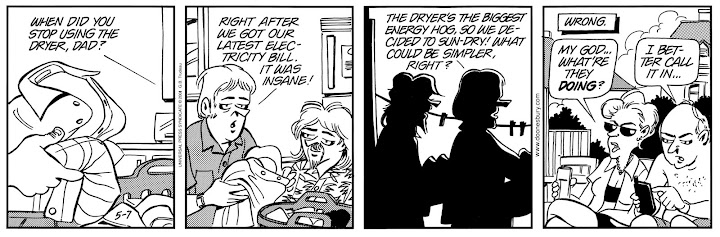 For all of the Doonesbury cartoons on Clotheslines, go HERE.
The Connecticut Chapter of the Sierra Club is lobbying to help pass this bill, contact Marty Mador for more information. The bill itself is quite simple. Project Laundry List is a nationwide group that promotes solar powered drying.

