
Do We have the Courage to
Try to do Something
about "Zombie" Trash?
Here's how one neighborhood faced
an impossible situation with mountains of trash:
They found sociable way to deal with it.
. . . . .
Will Middletown citizens come together to give it a try?
OWEN's LIST: Finding a Way to Recycle Zombie Trash
by Edward Humes
The Saturday Evening Post
December 2024 -- February 2025
hard-to-recycle items out of landfills.

The innocent question that changed Ryan Metzger’s life came the summer his son turned six. That’s when Owen asked about the ever-expanding bag of old batteries in the junk drawer.
“What’s going to happen to them, Dad?” he asked. “What are we supposed to do with them? We’re learning about recycling in school. Where do these get recycled?”
“Um,” Metzger said. “I don’t know.”
He knew where to get batteries, of course. And there were always instructions on correctly using them. But instructions on what to do when they died? Not so much. That’s why he fell into the habit of stuffing dead batteries into a drawer filled with all the other small, disused stuff that the family wasn’t sure what to do with.
“It’s heavy, Dad.” Owen waved the bag of batteries around.
It was pretty full, Metzger had to admit. Detritus from flashlights and old toys, smoke alarms and remote controls, with a crusty one that came out of an old toothbrush, these batteries were one of many types of problematic garbage. They had no obvious final resting place, much like garden chemicals, old phones, light bulbs, car parts, cooking grease … a ton of stuff, really, now that Metzger thought about it. You weren’t supposed to put any of that in the recycling bin. But you couldn’t put it with the landfill-bound trash, either, although that’s what many people ended up doing out of desperation or not caring or habit — or assuming (incorrectly) it would all somehow get properly sorted out by this impenetrable, mysterious entity called the waste management system.
“There’s got to be a place for old batteries,” Metzger assured his son. “Let’s find out.”
It took three phone calls to find a business near their Seattle home that would take their old batteries and ensure that they were actually recycled instead of just dumped somewhere.
Father and son decided to drive to this battery recycler so that Owen could make the delivery. On impulse, they asked a few neighbors if they had stashes of old batteries, too. Several did, so Ryan and Owen took those as well.
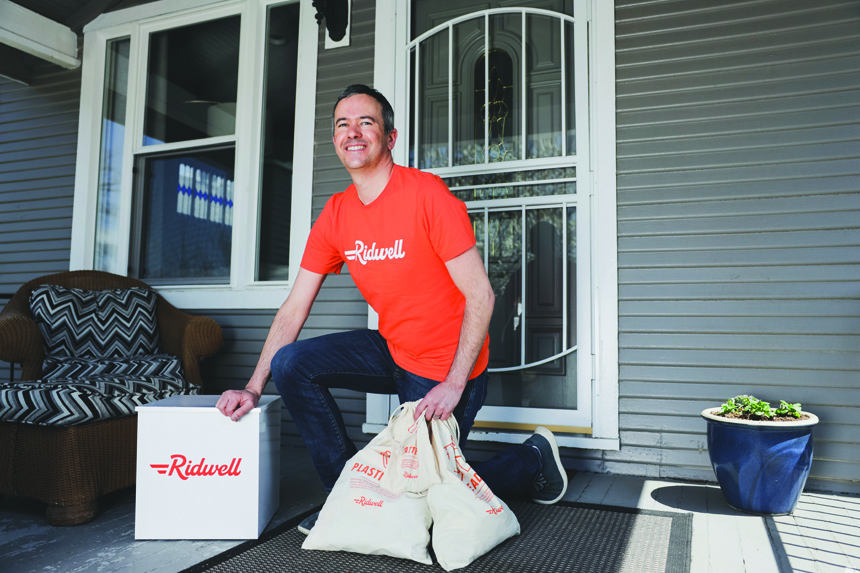
Owen was so delighted by this accomplishment that he and his father decided to make a regular project out of hauling one different type of problem trash every weekend to the right recycler, offering to do the same for neighbors in their Queen Anne section of Seattle. So they started gathering bent clothes hangers one weekend, burned-out light bulbs the next, and then plastic bags, wraps, pouches, bubble wrap, and Styrofoam, none of which plays well with community recycling programs. Demand kept expanding block by block as word got around about his little father-and-son project. Soon he had to create a subscriber email group to track it all, with a message going out each week on what sort of trash would be picked up next and when to leave it outside for pickup. They dubbed this “Owen’s List.”
Around this time, grateful subscribers to Owen’s List who had long felt guilty about their secret trashiness started offering the duo money. A few suggested they charge for the service. “I’d gladly give up a couple lattes a month in exchange for you taking care of this,” one neighbor said. “I bet a lot of people would.”
Could that be true? Could their father-and-son hobby become a business that would let him leave his tech job behind and do something to help save the world? Seattle residents took pride in living in one of America’s greenest cities, but would they really pay extra every month to change their trashy habits and help Owen’s List patch a gaping hole in the waste and recycling system?
Metzger renamed the service Ridwell, to better explain its mission at a glance, and then set out to find out.
To walk through the Ridwell warehouse in Seattle’s south-of-downtown district is to take a grand tour of the plastic industry’s unintended legacy: a disposable, single-use economy made of zombie trash that will not die.
The big room with the high ceiling and crammed aisles jars the senses with its piles, boxes, pallets, and bags of waste. It looks as if a landfill has been excavated, then its contents sorted, bundled, and neatly organized. That’s not far from reality, except this material has been rescued before its more typical destiny as landfill fodder, litter, or waterway pollution. And there is a lot of it: This “stock” changes day-to-day, the tide that never stops, with most of the warehouse contents turning over every two or three days.
The account above is part of an excerpt from an article in (believe it or not) The Saturday Evening Post, a magazine that some of us might remember from ... 'way back when. The article, however, leads me to think, in the here and now, "Why aren't we doing more of this?" Brainstorming! Imagining new ways of doing thing? Could we be thinking about what could do with a little neighborhood get-together and elbow grease by us, that is, We the People who care? And I know there are a lot of us who care in Middletown. How about talking with neighbors over the holidays, and talking about organizing Saturday morning walks for fun, just to pick up Friday night's "donations" of cans & bottles along the roadside? And get a little fresh air? We don't exactly need to "Love our Neighbor" to talk about taking a group walk, do we? We could just respect our neighborhood and want to pick up a bit of trash in a group to make it more memorable. Couldn't we? Build community, pick up trash, go have coffee at a neighbor's kitchen or back yard? Why not?
I mean, if you look at it in a certain way, it would take a neighborhood to do on a Saturday morning with lots of neighborly interaction & good will and getting to know each other, what grantwriters and committees accomplish with a lot more time, sweat and anguish of writing the grant proposal to find the money and wait for someone else to do the dirty work. . . . And at the same time, perhaps, as in Owen's neighborhood, our local neighborhood might eventually grow a volunteer effort into a successful business, a local employer, that could help to help "clean up" the notoriously unclean business of waste management.
. . . read more at the link below about how Owen's effort grew.
(OWEN's LIST: Finding a Way to Recycle Zombie Trash, continued.)


No comments:
Post a Comment