
Showing posts with label Eckersley Hall. Show all posts
Showing posts with label Eckersley Hall. Show all posts
Monday, May 14, 2012
Displays Available for Public to Review Proposed Senior and Community Center
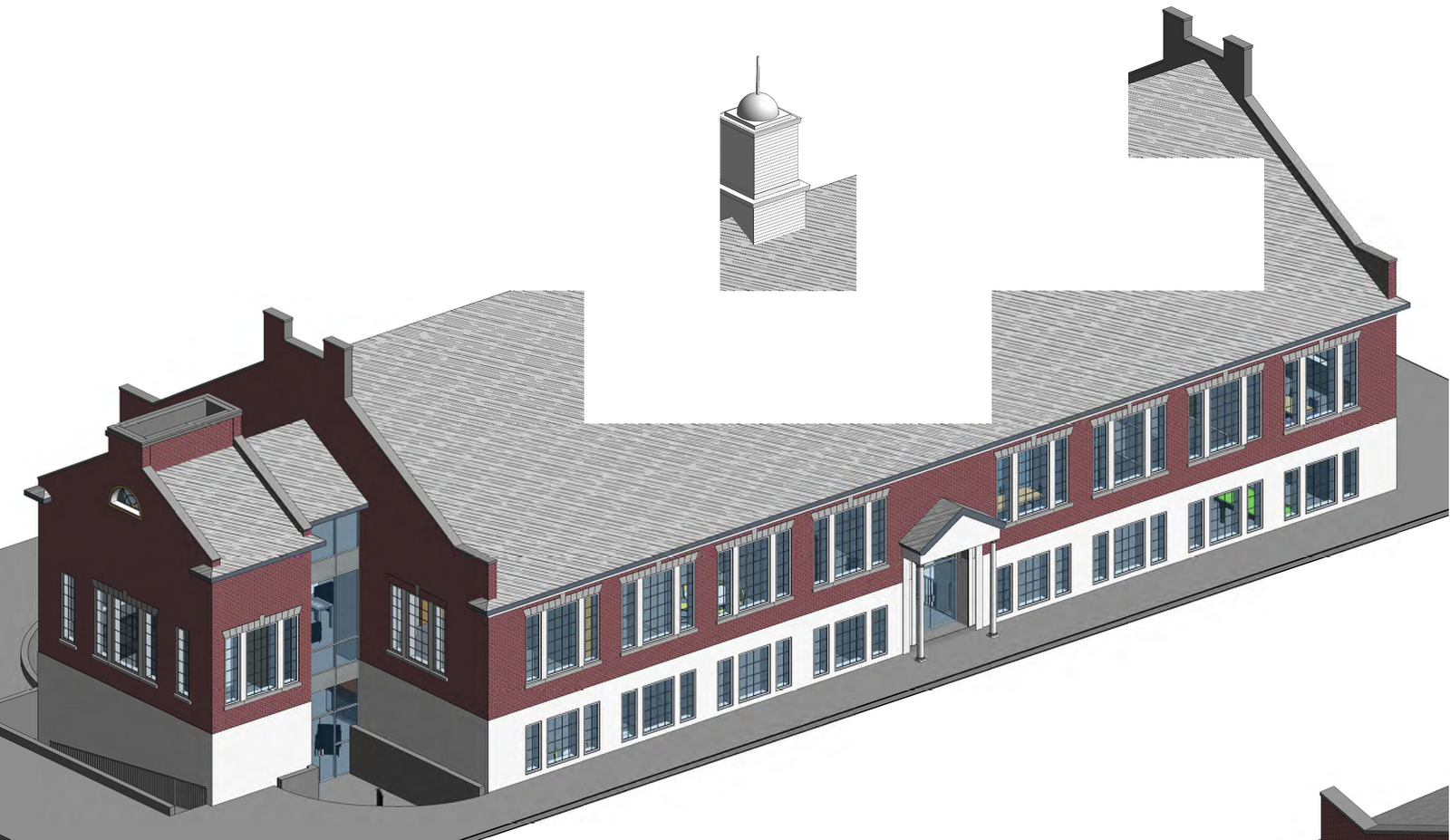
The Eckersley Hall Building Committee reports the completion of two exciting public displays presenting the proposed new Senior/Community Center for the Eckersley Hall Building. The displays with artist renderings are being used to educate the public about the plans for the site and building’s future design and the building amenities when completed. The lower floor includes reception, dining area, game room, and staff offices. Multi-purpose rooms, arts and crafts, library, and socialization rooms are on the upper floor. Other drawings include modifications to the front entrance of the historic building, access to the lower level, and an outdoor patio/bocce area.
The poster displays can be viewed at two locations. One set is at the current Senior Center, 150 Williams Street. The second set of displays is at the Russell Library, 123 Broad Street. A copy of the Eckersley Hall Building Committee Presentation before the Common Council is also available at the Information Services Desk on the second floor.
Russell Library Director Arthur Meyers is excited about housing the display at the Library. He pointed out “the Library is here to educate the public about the history of our city both past and into the future. I hope the public spends some time studying these plans and learning more about the proposed new Middletown Senior/Community Center because of the positive impact it will have on the growing senior population in our community.”
Anyone with comments or questions about these displays or the proposed Senior/Community Center can call Chair Ron Klattenberg (860) 604-1570 or Vice Chair, Phil Pessina, (860) 559-5211.


Tuesday, April 24, 2012
Middletown Senior Community Center Informational Meeting Meet
Middletown Senior/Community Center
Informational
Meeting
Tuesday,
May 1, 2012
6:30pm
Council
Chambers
Middletown
Municipal Building
245 DeKoven Drive
Public
Input Encouraged
If you have any questions or need additional information
about the workshop, contact Chair Ron Klattenberg, 860.604.1570
or Vice Chair Phil Pessina, 860.346.0348
Note: Both the Eckersley Hall Design and Mayor Drew's City Hall addition will be presented for public discussion
Tuesday, June 14, 2011
Senior Center Bond Ordinance Public Hearing Tonight
Thanks to Ed Dypa for calling attention to the Special Common Council meeting tonight, at 7:30. The only agenda item:
Eckersley Hall, originally built as a public school, was purchased from the city by St. Sebastian's Church for use as a school. The City purchased the school back from the church this spring, for use as a Senior Center and for Municipal Offices.
The conceptual design submitted to the city by the architects Quisenberry Acari came with a very preliminary estimate that the total cost would be $1.7M. Tonight's hearing is on a $750,000 bond to cover part of the cost of renovations.
 Councilman Ron Klattenberg has been a leader in pushing for the Eckersley Hall purchase and renovation. In an interview with The Eye this morning, Klattenberg said that the bond would be use to begin the renovations, paying for Access by the Disabled, a new roof, a new boiler, and bringing the heating/cooling up to code. He said there were other funds that would also be used, including $190,000 in HUD money that would be reallocated, and $37,000 which had been allocated for the approval process but had not yet been spent.
Councilman, and Mayoral candidate, Dan Drew was opposed last fall to the purchase of Eckersley Hall, saying the total cost for renovations was not clear and expressing concern that the reallocation of grant money would deprive other city organizations of funding. Drew told The Eye that since the city now owns the building, he fully supports the $750,000 bond issuance.
Klattenberg said the total cost of the renovations could not be known until the design of the space is finalized, and until then it did not make sense to bond the total cost, "The final number might be higher or lower."
 Klattenberg said the renovations would be a multi-stage process, "Once we have the building up to code ... then we can move forward with the building." Klattenberg suggested that the initial work bringing the building up to code could also lead to other opportunities for funding.
Klattenberg and Drew each said that once the total cost was clear, the Council would likely consider a second bond.
Any bonds greater than $750,000 must be approved by voters in a city-wide referendum, according to the City Charter.
Some of the previous coverage on the Council's decision to purchase Eckersley Hall:
Public hearing on Bond Ordinance for Eckersley Hall
Eckersley Hall, originally built as a public school, was purchased from the city by St. Sebastian's Church for use as a school. The City purchased the school back from the church this spring, for use as a Senior Center and for Municipal Offices.
The conceptual design submitted to the city by the architects Quisenberry Acari came with a very preliminary estimate that the total cost would be $1.7M. Tonight's hearing is on a $750,000 bond to cover part of the cost of renovations.
Councilman, and Mayoral candidate, Dan Drew was opposed last fall to the purchase of Eckersley Hall, saying the total cost for renovations was not clear and expressing concern that the reallocation of grant money would deprive other city organizations of funding. Drew told The Eye that since the city now owns the building, he fully supports the $750,000 bond issuance.
Klattenberg said the total cost of the renovations could not be known until the design of the space is finalized, and until then it did not make sense to bond the total cost, "The final number might be higher or lower."
Klattenberg and Drew each said that once the total cost was clear, the Council would likely consider a second bond.
Any bonds greater than $750,000 must be approved by voters in a city-wide referendum, according to the City Charter.
Some of the previous coverage on the Council's decision to purchase Eckersley Hall:
Council Hears Plan For Senior Center at Eckersley Hall
•Buying St. Sebastians School Could Cut Aid To Those in Need (commentary by Dan Drew)
•Council Approves Purchase of St. Sebastian's School
•Planning and Zoning Approves Purchase
Senior Center Grant Sent Back to Committee
Tuesday, December 28, 2010
Conceptual Design For Senior Center To Be Reviewed Wednesday
There will be a special meeting of the Design Review and Preservation Board tomorrow evening (Wednesday, December 28, 6PM, Room 208), to discuss the plans for renovations to the Eckersley Hall School Building. Eckersley Hall, on Durant Terrace behind Illiano's Pizza on South Main, was built as a public elementary school after World War I, and used most recently by Saint Sebastian's Church as a private school. The Common Council voted to purchase the building from Saint Sebastian for $800,000 for use as a Senior Center and Municipal offices.
The architectural firm Quisenberry Acari has created conceptual plans for the conversion. The Planning Department has posted on its web site a Site Plan Map, a Floor Plan and Elevation Rendering, and 3D views of the exterior.
The largest proposed change to the exterior is the addition of large structure on the south end to re-orient the building by creating a new main entrance, to house stairs, and most importantly to house an elevator for handicapped access. Thus, instead of a building which is symmetrical and entered from the long side with many windows at ground level, people will enter towards the end of the building in an addition with no windows at ground level. The architects have echoed the original on the elevator addition, but the addition de-emphasizes the Dutch Façade which now symmetrically bookends the school building.
According to the Planning Department web site,
Middletown's Design Review and Preservation Board was set up by Ordinance, section 26-10 in 1998, to act in an advisory capacity to the Planning and Zoning Committee. ...
The board's goal is not to get in the way of improving Middletown, but rather preserve and promote the character and heritage of our neighborhoods and business areas. [emphasis mine]
The Design and Review Board reviews signs on all of the city's commercial corridors, and significant changes to properties in the downtown and village districts. Additionally, they are charged with reviewing any significant changes to properties of historic significance. The Eckersley Hall building is on the Greater Middletown Preservation Trust's Inventory of Historical and Architectural Resources, and thus any changes must be reviewed by DRPB.
According to city guidelines the DRPB refers to the National Department of the Interior Standards for the Treatment of Historic Properties. These include the following statement:
Finally, alterations and new construction needed to meet accessibility requirements under the Americans with Disabilities Act of 1990 should be designed to minimize material loss and visual change to a historic building.The City's summary of those guidelines also include the following:
New additions, exterior alterations, or related new construction shall not destroy historic materials that characterize the property. The new work shall be differentiated from the old and shall be compatible with massing, size, scale, and architectural features to protect the historic integrity of the property and its environment.Another sentence in the City's guidelines speaks to the importance of preserving historically significant artwork, such as the mural painted by WPA artist Albert McCutcheon during the Depression:

Significant archaeological resources affected by a project shall be protected and preserved. If such resources must be disturbed, mitigation measures shall be undertaken.
After review by the DRPB, the project next goes to the Planning and Zoning Commission. They have scheduled a Public Hearing for this at their January 12th meeting (7PM, Council Chambers).
Thursday, October 21, 2010
St. Sebastian School Building Purchase
The Middletown Press reported today on the Public Works Commission discussion about a City purchase of the St. Sebastian School Building. In a motion by Councilman David Bauer and a second by Councilman Ron Klattenberg, the Public Works Commission voted to negotiate the purchase in order to provide space for the senior center.
 The Finance and Government Operations Committee discussed the purchase of a historic school building at their meeting on Wednesday evening.
Eckersley Hall
St. Sebastian School will close at the end of this school year, a decision of the Norwich Diocese, previously reported in the Middetown Press. St. Sebastian School was founded in 1944, and occupies a building which was built in 1872 as Eckersley Hall, part of the Middletown public school system. It is on Durant Terrace, just behind Illiano's Pizza on S. Main Street. When St. Sebastian bought Eckersley Hall, the sales agreement stipulated that if the building ceased being used for education, the city would have the right of first refusal to purchase the building from St. Sebastian. Councilman Gerald Daley speculated that the city had sold the school to St. Sebastian for $1 [see correction below].
With the closing of the school, St. Sebastian has offered the building to the city for a price of $1.3 million. Planning Director Bill Warner said that all departments had contemplated possible uses for the school building, but none foresaw a benefit to the city. Councilmen Daley and Ron Klattenberg pressed Warner, but it seemed apparent that the building is too small, not handicap accessible, and in an inconvenient location for use as a senior center, city school, administration building, or any of the other possible city uses. The F&G Committee voted unanimously against purchasing the school.
-----------------
Eckersley Hall was built as an elementary school in 1870, to serve the children of the Durant neighborhood, which was the concentration of houses around what is now South Main Street. St. Sebastian school moved into the Eckersley Hall building in the 1980s. The Eckersley Hall School Building, which is on the Middletown Historic Properties List, was what the F&G declined to purchase (for $1.3 million) at their meeting on Wednesday evening.
Also in my article on the F&G meeting, I reported the speculation by Councilman Daley that St. Sebastian had bought their current building from the city for $1. Mayor Giuliano addressed this speculation, as well as the history of St. Sebastian School in a comment on a March 27th article in the Middletown Press about the closing of St. Sebastian. Here is all of his comment related to the school building:
This makes the second time that the City has discussed this purchase. The first discussion was at the April 30th, 2009 meeting of the Finance and Government Operations Committee, chaired by Ron Klattenberg.
I thought it might be of interest to dig back in the archives of The Eye for coverage of this discussion. The following photographs and text are from two articles by me, one on the monthly meeting of F&G, and a second on the history of the building (the second article corrected mistakes of history I made in the first, I have incorporated the corrections into the two extracts below).
------------------
From April 30, 2009:
 The Finance and Government Operations Committee discussed the purchase of a historic school building at their meeting on Wednesday evening.
Eckersley Hall
St. Sebastian School will close at the end of this school year, a decision of the Norwich Diocese,
 previously reported in the Middetown Press. St. Sebastian School was founded in 1944, and occupies a building which was built in 1872 as Eckersley Hall, part of the Middletown public school system. It is on Durant Terrace, just behind Illiano's Pizza on S. Main Street. When St. Sebastian bought Eckersley Hall, the sales agreement stipulated that if the building ceased being used for education, the city would have the right of first refusal to purchase the building from St. Sebastian. Councilman Gerald Daley speculated that the city had sold the school to St. Sebastian for $1 [see correction below].
With the closing of the school, St. Sebastian has offered the building to the city for a price of $1.3 million. Planning Director Bill Warner said that all departments had contemplated possible uses for the school building, but none foresaw a benefit to the city. Councilmen Daley and Ron Klattenberg pressed Warner, but it seemed apparent that the building is too small, not handicap accessible, and in an inconvenient location for use as a senior center, city school, administration building, or any of the other possible city uses. The F&G Committee voted unanimously against purchasing the school.
-----------------
From May 1, 2009:
Eckersley Hall was built as an elementary school in 1870, to serve the children of the Durant neighborhood, which was the concentration of houses around what is now South Main Street. St. Sebastian school moved into the Eckersley Hall building in the 1980s. The Eckersley Hall School Building, which is on the Middletown Historic Properties List, was what the F&G declined to purchase (for $1.3 million) at their meeting on Wednesday evening.
Also in my article on the F&G meeting, I reported the speculation by Councilman Daley that St. Sebastian had bought their current building from the city for $1. Mayor Giuliano addressed this speculation, as well as the history of St. Sebastian School in a comment on a March 27th article in the Middletown Press about the closing of St. Sebastian. Here is all of his comment related to the school building:
No, it is not true that the City sold St. Sebastian School to the Parish for $1.00. St. Sebastian bought the former Johnson School on Green Street in the 1950s for $25,000 (back when this amount of money was actually worth something). In the 1980s, when it became obvious that the Green Street/Ferry Street neighborhood where I attended school during the 1950s and 1960s was declining, the Parish made a trade with the City. We gave them the Green Street property in exchange for the former Eckersley Hall School on Durant Terrace. Since then, the parish has made extensive improvements to the physical plant, including adding a computer lab, air conditioning, a separate annex to house the middle school, playground equipment and audio-visual amenities, among other things. This is value put into the property via the contributions of St. Sebastian's parishioners, not to mention the staggering subsidies they have contributed annually to sustain the school's operations. As I stated, once this year is over, if there is not going to be a combined regional school, the property should be marketed and the sale proceeds put in St. Sebastian's treasury. This way, the parish can repay its debts to the cemetery trust fund (from which it borrowed heavily to sustain the school) and to the Diocese, which underwrote the school's insurance obligations.
Friday, May 1, 2009
Correction on St. Sebastian School Building
In my article on the Finance and Government Committee meeting of Wednesday evening, I reported that the city had decided against purchasing the St. Sebastian School building. I gave a little bit of the history of the building, which I based on a history of Middletown available at the Planning and Zoning website, written by B.A. Cleary in 1979. Unfortunately, I got the history of the building wrong, and reported an inaccurate comment about how St. Sebastian acquired the school building.
The Cleary history of Middletown is extremely informative and I highly recommend it for an overview of our city's past, but in this case the information was out of date. Another outstanding history of Middletown was written by Elizabeth Warner (A Pictorial History of Middletown, published by Great Middletown Preservation in 1990). Liz clarified for me the history of the school building on Durant Terrace, which is now occupied by St. Sebastian. The Johnson School, which I said was the Durant Terrace building, is actually on Green Street (where it now houses the eponymous Arts Center), and was an earlier home to St. Sebastian.

Eckersley Hall was built as an elementary school in 1870, to serve the children of the Durant neighborhood, which was the concentration of houses around what is now South Main Street. St. Sebastian school moved into the Eckersley Hall building in the 1980s. Thus, it is the Eckersley Hall School Building, which is on the Middletown Historic Properties List, that the F&G declined to purchase (for $1.3 million) at their meeting on Wednesday evening.
Also in my article on the F&G meeting, I reported the speculation by Councilman Daley that St. Sebastian had bought their current building from the city for $1. Mayor Giuliano addressed this speculation, as well as the history of St. Sebastian School in a comment on a March 27th article in the Middletown Press about the closing of St. Sebastian. Here is all of his comment related to the school building:
 reported that the city had decided against purchasing the St. Sebastian School building. I gave a little bit of the history of the building, which I based on a history of Middletown available at the Planning and Zoning website, written by B.A. Cleary in 1979. Unfortunately, I got the history of the building wrong, and reported an inaccurate comment about how St. Sebastian acquired the school building.
The Cleary history of Middletown is extremely informative and I highly recommend it for an overview of our city's past, but in this case the information was out of date. Another outstanding history of Middletown was written by Elizabeth Warner (A Pictorial History of Middletown, published by Great Middletown Preservation in 1990). Liz clarified for me the history of the school building on Durant Terrace, which is now occupied by St. Sebastian. The Johnson School, which I said was the Durant Terrace building, is actually on Green Street (where it now houses the eponymous Arts Center), and was an earlier home to St. Sebastian.

Eckersley Hall was built as an elementary school in 1870, to serve the children of the Durant neighborhood, which was the concentration of houses around what is now South Main Street. St. Sebastian school moved into the Eckersley Hall building in the 1980s. Thus, it is the Eckersley Hall School Building, which is on the Middletown Historic Properties List, that the F&G declined to purchase (for $1.3 million) at their meeting on Wednesday evening.
Also in my article on the F&G meeting, I reported the speculation by Councilman Daley that St. Sebastian had bought their current building from the city for $1. Mayor Giuliano addressed this speculation, as well as the history of St. Sebastian School in a comment on a March 27th article in the Middletown Press about the closing of St. Sebastian. Here is all of his comment related to the school building:
No, it is not true that the City sold St. Sebastian School to the Parish for $1.00. St. Sebastian bought the former Johnson School on Green Street in the 1950s for $25,000 (back when this amount of money was actually worth something). In the 1980s, when it became obvious that the Green Street/Ferry Street neighborhood where I attended school during the 1950s and 1960s was declining, the Parish made a trade with the City. We gave them the Green Street property in exchange for the former Eckersley Hall School on Durant Terrace. Since then, the parish has made extensive improvements to the physical plant, including adding a computer lab, air conditioning, a separate annex to house the middle school, playground equipment and audio-visual amenities, among other things. This is value put into the property via the contributions of St. Sebastian's parishioners, not to mention the staggering subsidies they have contributed annually to sustain the school's operations. As I stated, once this year is over, if there is not going to be a combined regional school, the property should be marketed and the sale proceeds put in St. Sebastian's treasury. This way, the parish can repay its debts to the cemetery trust fund (from which it borrowed heavily to sustain the school) and to the Diocese, which underwrote the school's insurance obligations.
Thursday, April 30, 2009
City turns down opportunity to purchase St. Sebastian School Building
The Finance and Government Operations Committee discussed the purchase of a historic school building at their meeting on Wednesday evening. They also discussed the Swine Flu situation and its possible impact on city finances. Through unanimous and routine votes, they supported expenditures by a variety of city departments. Final approval of the expenditures rests with the full Common Council.The Johnson School (see correction below)
St. Sebastian School will close at the end of this school year, a decision of the Norwich Diocese,
previously reported in the Middetown Press. St. Sebastian School was founded in 1944, and occupies a building which was built in 1872 as The Johnson School, part of the Middletown public school system. It is on Durant Terrace, just behind Illiano's Pizza on S. Main Street. When St. Sebastian bought the Johnson School building, the sales agreement stipulated that if the building ceased being used for education, the city would have the right of first refusal to purchase the building from St. Sebastian. Councilman Gerald Daley speculated that the city had sold the school to St. Sebastian for $1.With the closing of the school, St. Sebastian has offered the building to the city for a price of $1.3 million. Planning Director Bill Warner said that all departments had contemplated possible uses for the school building, but none foresaw a benefit to the city. Councilmen Daley and Ron Klattenberg pressed Warner, but it seemed apparent that the building is too small, not handicap accessible, and in an inconvenient location for use as a senior center, city school, administration building, or any of the other possible city uses. The F&G Committee voted unanimously against purchasing the school.
Note added: I have posted a correction of several mistakes in the above information. The most important to note is that the school building was the home of Eckersley Hall, built in 1870. The Johnson School (1872) was on Green Street. Both schools are on the list of Middletown Historic Properties.
Swine Flu
George Dunn, Director of Emergency Management, was at the F&G meeting to gain approval for a grant and for waiving a bid requirement. After those were approved, he took the occasion to discuss Middletown's response to the Swine Flu pandemic. He said that he has assembled a crisis management team which includes representatives from the Health Department, emergency responders, the hospital, and the school system. Dunn said that all parties are working well together, and that Middletown was working closely with 7 regional towns.
Dunn said that the situation was evolving quickly and unpredictably, "By tomorrow it might be completely over or ten times worse." Daley cautioned that there is a "need to create a balance between too much panic and burying our heads in the sand." Dunn said that it was approaching the time for emergency responders to wear protective equipment (masks), and that the F&G committee would possibly be receiving a request to purchase additional equipment if the situation becomes worse.
Riverview Parking Garage and other requests

The committee approved the request by Public Works for $35,000 from the General Fund to be used for structural repairs and improvements to the Riverview Parking Garage, to be paid back upon receipt of state funding through the Local Capital Improvement Program (LOCIP). The committee also approved $40,000 to be disbursed to Public Works to cover a shortfall in the budgeted funding for sand and salt.
Subscribe to:
Posts (Atom)